They met at Black Mountain College in the summer of 1944 and married that November. Theirs was a partnership — but each had a long and distinguished career of their own, working in many media though primarily as sculptors. Much of the work gathered here is early, and has never been shown before.
Artists
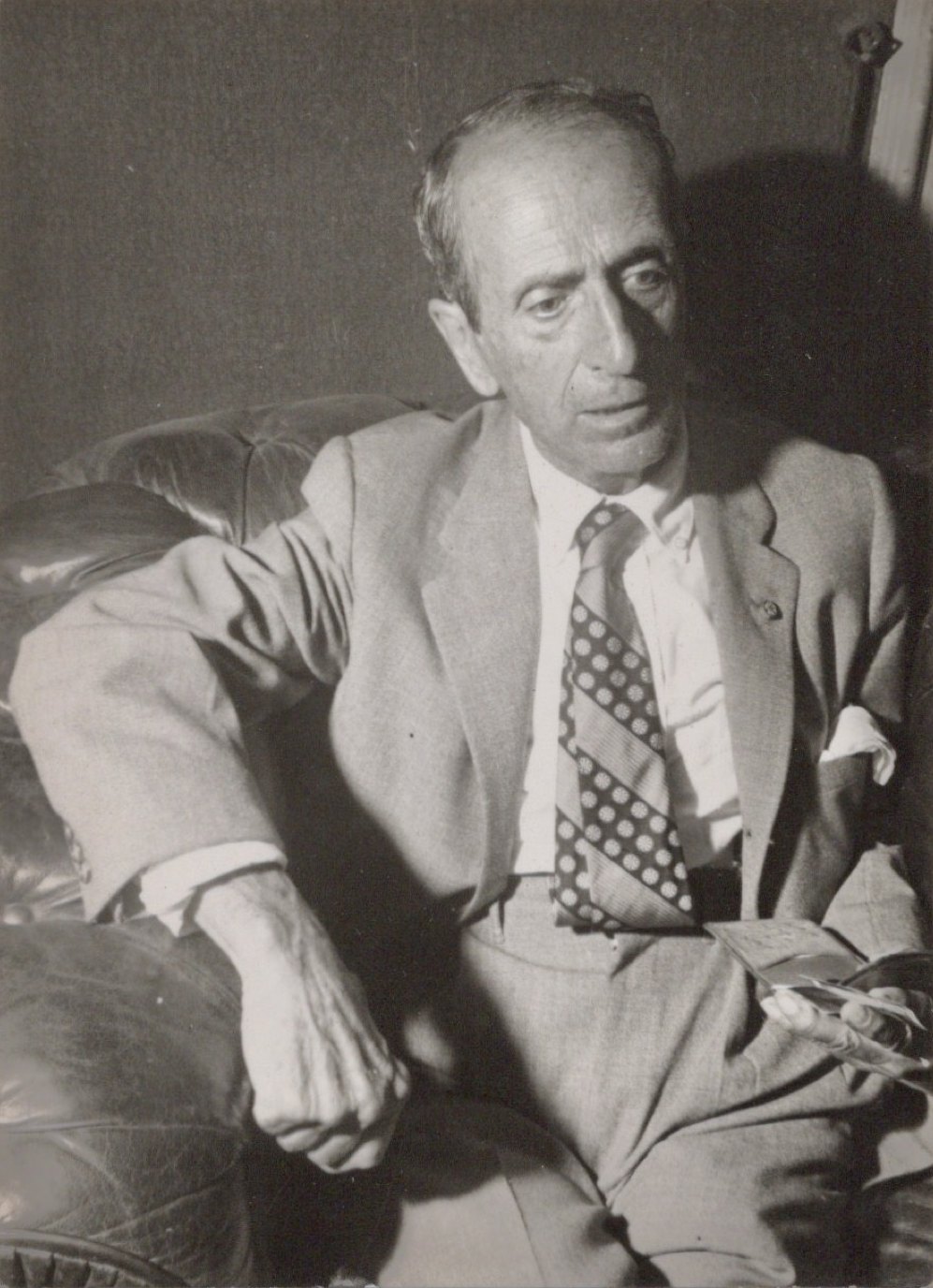
José de Creeft was born in Guadalajara, Spain, in 1884 and raised in Barcelona. By the age of eleven he was working as an apprentice — making small Nativity figures — and, with little formal schooling, gained his real education in the artistic workshops and foundries of Barcelona and Madrid. In 1900 he entered the Madrid workshop of Agustín Querol and studied drawing and sculpture alongside the painter Ignacio Zuloaga.
In 1905 he went to Paris carrying a letter of introduction from Zuloaga to Auguste Rodin, who advised him to take formal classes at the Académie Julian. He took a studio in the Bateau-Lavoir, where his neighbors included Picasso, Juan Gris, Manolo, César Vallejo, and Apollinaire. In 1906 he won the Académie’s first prize for his Torso.
From that point he was among the foremost exponents of taille directe. He carved his first direct stone head in 1916; in 1918 he completed Le Poilu, an eighteen-foot granite figure dedicated to the French infantryman. In 1925 he assembled Picador, an equestrian figure built from chimney tubes, scrap metal, and other found materials — and the following year encouraged a young Alexander Calder, who took direct-carving lessons from him.
De Creeft emigrated to the United States in 1929 and settled in New York. His work entered the major collections within a decade: the Brooklyn Museum acquired Semitic Head in 1938, the Museum of Modern Art Saturnia in 1940, and the Whitney The Cloud in 1941 and Himalaya in 1943. In 1942 his Maternity won first prize in the “Artists for Victory” exhibition at the Metropolitan Museum. He taught at the New School for Social Research and, for more than three decades, at the Art Students League of New York.
In 1955 he was commissioned to create the bronze tableau Alice in Wonderland; dedicated in Central Park on May 7, 1959, and designed to be climbed on, it remains among the best-loved public sculptures in New York. A retrospective opened at the Whitney in 1960. Named late in life an “honored son” of Guadalajara and a Comendador of the Order of Isabella the Catholic, José de Creeft continued to carve almost to the end. He died in New York on September 11, 1982, at the age of ninety-seven.
Selected Honors
- 1906 First Prize for Torso, Académie Julian, Paris
- 1942 First Prize, “Artists for Victory,” Metropolitan Museum of Art
- 1951 George D. Widener Memorial Gold Medal, Pennsylvania Academy of the Fine Arts
- 1955 Elected, National Institute of Arts and Letters
- 1960 Retrospective, Whitney Museum of American Art
- 1964 Academician, National Academy of Design
- 1973 Comendador, Order of Isabella the Catholic, Madrid
Teaching
- 1932–48 The New School for Social Research, New York
- 1944 Black Mountain College, North Carolina (summer)
- 1944–79 Art Students League of New York
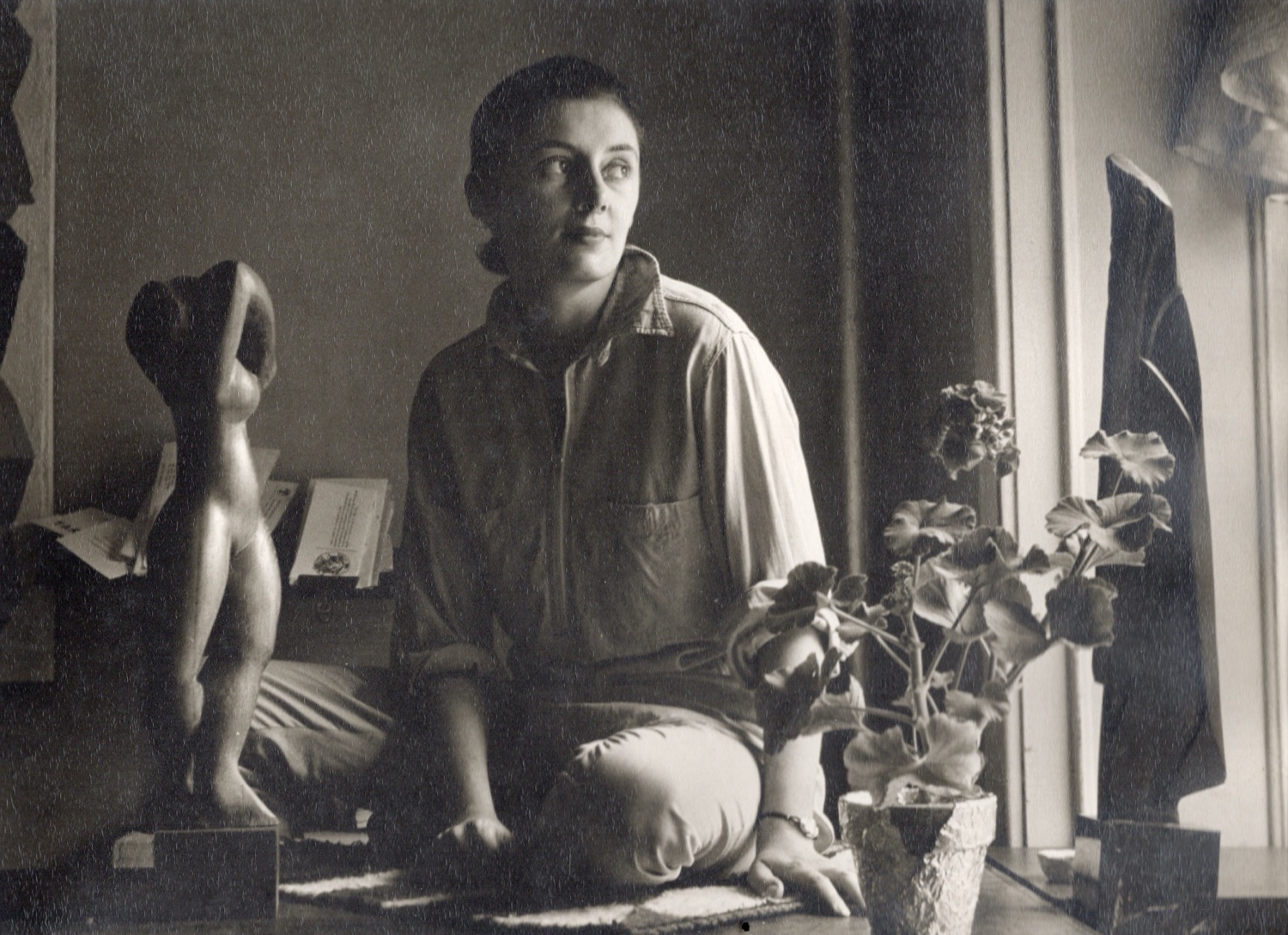
Lorrie Goulet was born in Riverdale, in the Bronx, in 1925. Her education in the arts began extraordinarily early: from 1933 she studied with the ceramicist Aimée Voorhees at the Inwood Potteries Studios, and at the age of eleven took part in her first group exhibition, at the New York Museum of Natural History. After the family moved to Los Angeles she apprenticed, in 1940, to the ceramicist Jean Rose.
In 1943 she entered Black Mountain College in North Carolina — one of the most radical experiments in American art education — studying drawing with Josef Albers and weaving with Anni Albers. During the summer session she took the sculpture class that set the course of her life.
Goulet became a direct carver, working stone and wood without models or mechanical aids. Across more than six decades her subject was, almost without exception, the female form — rendered not as representation but as presence. She carved in green serpentine, grey alabaster, pink granite, white Carrara and black Tennessee marble, limestone and granite, and in cedar, ebony, mahogany, olive, oak, and walnut. Each stone, she felt, had its own personality; she spoke of the music of carving, of the rhythms of the body and the stone working in tandem.
Her first solo exhibition came in 1948 at the Clay Club, later the Sculpture Center, and she exhibited in group shows at the Whitney through the following decade. She received public commissions — a ceramic relief for a Bronx branch of the New York Public Library in 1958, another for the Bronx Municipal Hospital in 1961, and a stainless-steel relief for a Bronx civic building in 1971. From 1962 she co-created and starred in the CBS children’s sculpture series Around the Corner, bringing the art to a national audience. From 1971 to 1986 she was represented by Kennedy Galleries.
She taught at the Museum of Modern Art’s People’s Art Center from 1957, the New School from 1961, and the Art Students League — where she taught direct carving in stone and wood — from 1981 until 2004. In 1998 the National Museum of Women in the Arts presented a full retrospective, “Fifty Years of Making Sculpture.” Her work is held in more than two dozen public collections, among them the Hirshhorn and the National Academy of Design. Lorrie Goulet died in New York in 2021.
Selected Honors
- 1949–50 First Prize, Norton Gallery and the Society of the Four Arts, Florida
- 1964 First Prize, Westchester County Art Society
- 1997 Richard Florsheim Foundation Grant
- 1998 Retrospective, National Museum of Women in the Arts
- 2001 Malvina Hoffman Award, National Academy of Design
Education & Teaching
- 1943–44 Black Mountain College, North Carolina
- 1957 The Museum of Modern Art, People’s Art Center
- 1961–75 The New School, New York
- 1981–2004 Art Students League of New York